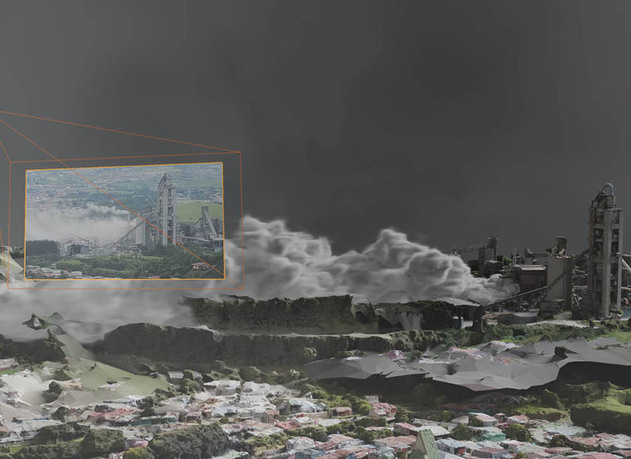
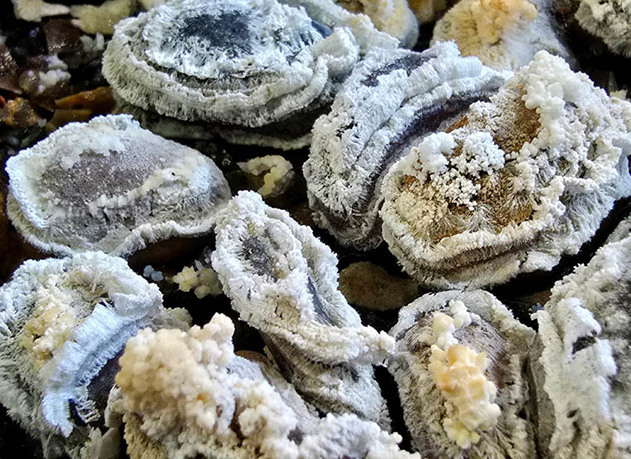
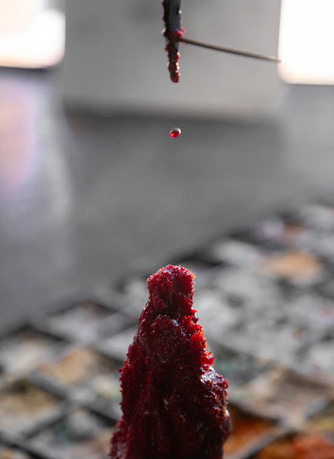
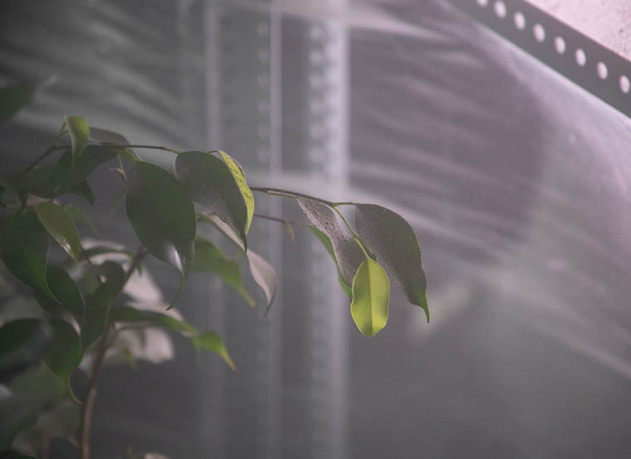
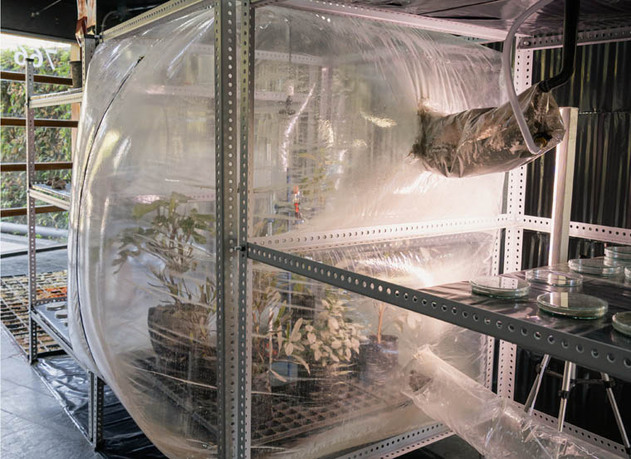
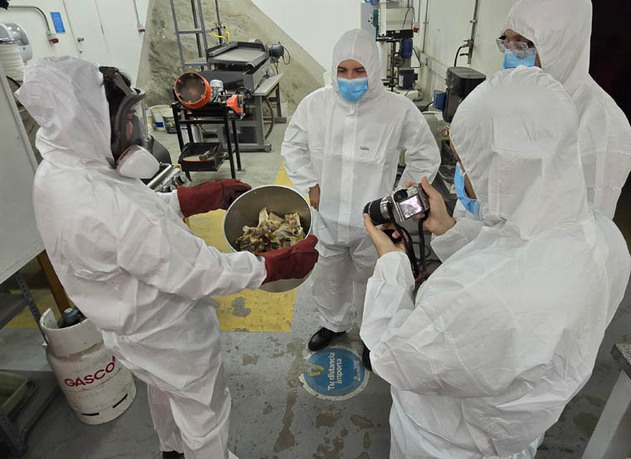
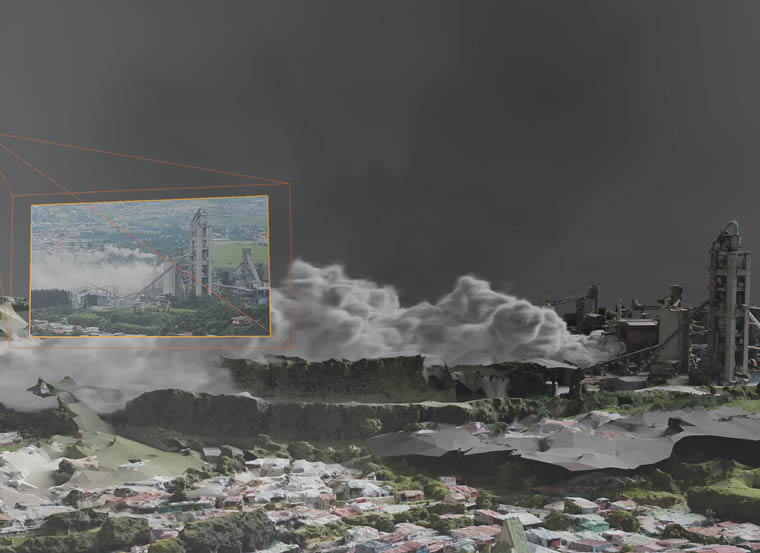
EHTC, “Untitled,” 2026. Photogrammetry model and digital simulation. Courtesy of EHTC Archive. Image: Javier Peña
Procesos Salvajes [Wild Processes] is an artistic research project that reflects and intercepts the shifts and realignments between natural (plant and mineral) and industrial materials, as well as the multispecies assemblages that shape the disputes over the surfaces they accelerate. Through devices and material experiments, the project seeks to intercept the biological and geological times of calcium carbonate (limestone) and its permutations to push time through materials, forcing the natural and industrial processes that have made cement more abundant than life itself. These experiments examine the Latin American construction materials industry and its political ecologies through self-accelerating assemblages that stress the process of artistic creation and expand it to occupy quarries, construction material depots, laboratories, kilns, and construction debris disposal sites, to converge in the exhibition space, and escape into the body, to literally become part of our bone structure.
Carlos A. Segura is editor-in-chief of Operaciones, a publisher based in Costa Rica, where he develops and directs editorial projects related to disciplinary practices in the culture of architecture and contemporary art. He has been a guest lecturer in the Curatorship and Contemporary Art program at La Fototeca, Galería Extra, and the National Foundation for Fine Arts and Culture of Guatemala; lecturer in the theory, philosophy, and history department at the School of Architecture at LCI VERITAS University; and visiting professor of Interdisciplinary culture projects and researcher in residence at the School of Architecture at Andrés Bello University. He has directed independent and academic research programs, including Experiments in History, Theory, and Criticism (eHTC). He develops his editorial practice in architecture and environmental humanities, which directly informs his research practice at eHTC. He holds a bachelor’s degree in architecture from the University of Costa Rica.
Juan Carlos Espinosa is an architect and urban planner. He is technical manager of the National Workers’ Housing Fund Institute (INFONAVIT) and assistant professor at the Universidad Iberoamericana. He is cofounder and research director of Proyector, a curatorial platform in Mexico City devoted to the promotion of architecture research. His work includes research at the Institute for Urban Futures, Montreal; the Open-Output Foundation, New York; and membership in the Center for Sustainable Design Strategies at Pratt Institute, New York. In Mexico, he has served as a consultant for UN-Habitat and as coordinator of the Federal Program for Public Space Recovery at the Ministry of Social Development. He holds a degree in architecture and a master’s in architectural design from UNAM, a master’s in theory, analysis, and history from Escuela Técnica Superior de Arquitectura de Madrid (ETSAM), and a master’s in architecture and urban design from Pratt Institute, New York.
Tania Tova Torres is an architect, writer, and curator. She is cofounder and director of Proyector, a curatorial platform based in Mexico City devoted to the promotion of architecture research. She was Wortham Fellow at the Rice University School of Architecture and previously worked at the Canadian Centre for Architecture in Montreal and the Arthur Ross Architecture Gallery in New York. In 2019, she was appointed curator of architecture of the Abierto Mexicano de Diseño, and a fellow of the Future Architecture Platform in 2018. She was research and editorial consultant for the German Cooperation Agency for Sustainable Development, developed projects for the University Museum of Science and Art, the National Council for Educational Development, and the UNAM School of Architecture. Tovar is trained as an architect by the UNAM; studied at the Staatliche Akademie der Bildenden Künste Stuttgart; and holds a Masters in Critical, Curatorial and Conceptual Practices in Architecture from Columbia University Graduate School of Architecture, Planning and Preservation.