Publication
-
Holy Modern: Technocratic Fascism, Imperial Architectures, and Opus DeiMaría González Pendás
AuthorDuke University Press, 2027 -
GRANTEE
María González PendásGRANT YEAR
2026

Madlener House
4 West Burton Place
Chicago, Illinois 60610
Telephone: 312.787.4071
info@grahamfoundation.org
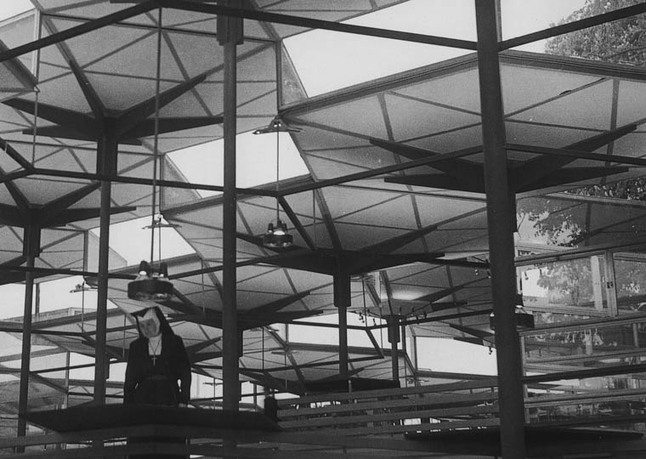
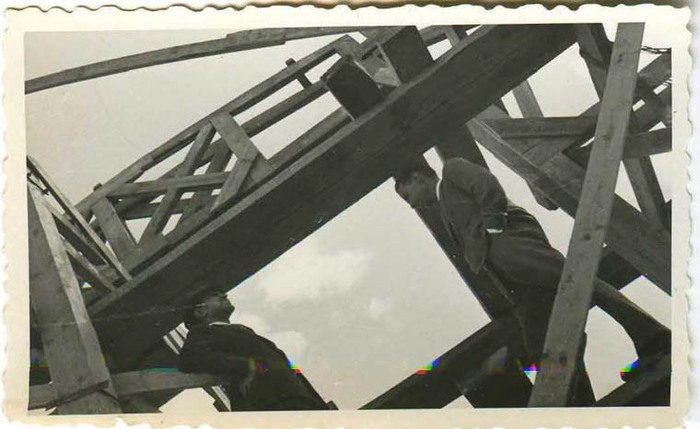
Fernando Higueras, “Pabellón de España (‘Franquista Pavilion’), Expo ’58, Brussels,” 1958. Photograph, size unknown. From Andrés Canovas, ed. “Pabellon de Bruselas ’58,” (Madrid: Ministerio de Vivienda 2005). Courtesy Fernando Higueras Foundation
From the mid-1930s through the 1950s, a new revolutionary subject emerged at the intersection of fascism and Catholicism: a man who practiced modernization as imperial regeneration, technocracy as evangelization, and innovation as spiritual social cleansing. For this actor, the ongoing mission of empire was pious, technological, invisible—and architecture served as a primary site for its enunciation. Traversing homes, laboratories, building sites, pavilions, government buildings and the occasional church, Holy Modern reveals how architecture forged the political theology and aesthetics of this “cryptic technofascism” within the Franquista dictatorship (1939–75) and at the genesis of Opus Dei. As the first critical cultural history of this potent yet obscure Catholic organization, the book follows its founding members as they leveraged a “holy aesthetics” of modernization to revitalize the imperial myth of Hispanidad and promote a global revolution of the religious and neoliberal ultra-right—one that, in its formative years, endowed modern architecture with an enchanting and formidable political power.
María González Pendás is assistant professor at Cornell University. A historian of architectural technologies, aesthetics, and politics, she investigates the modernity/coloniality bind that shaped the global Spanish world in the nineteenth and twentieth centuries. Her research explores the legacies of imperialism in architectural relations of labor and production, especially around concrete technologies; of race and religion; of technocracy, fascism, and modernism in and across Spain, Mexico, Morocco, and the Atlantic. She is the coeditor of Pious Technologies and Secular Designs, a special issue in Grey Room (2022), and curator of the Labor Un:imagined and Who Built Cornell? symposium and exhibition (2024). Her writing has appeared in numerous publications, supported by the Society of Architectural Historians, the Mui Ho Center for Cities, the Fulbright, and the Society of Fellows in the Humanities at Columbia University, among others. She holds a professional degree in architecture from the Polytechnic University of Madrid and a PhD in architectural history and theory from Columbia University.
Copyright © 2008–2026 Graham Foundation. All rights reserved.